
Dolby Vision vs Dolby Vision 2: What’s Better in 2026 & Is the Upgrade Worth It?
Dolby Vision vs Dolby Vision 2 explained. Learn what’s new, how they differ, and whether upgrading your TV for Dolby Vision 2 is worth it in 2026.
3/6/20266 min read
Introduction
Several months ago I was with a friend who was trying to choose a new TV. As most of us do, he opened some pages of the products and was soon left confused. Each TV appeared to have a long list of features. HDR10, Dolby, Mini LED, OLED, and so on.
Then one thing caught his attention. Some newer models were mentioning Dolby Vision 2.
His first reaction was simple. “Wait, I thought that Dolby Vision was the top HDR format. What is Dolby Vision 2 now?”
I was also curious about that question.
The Dolby Vision is not new and is popular among streaming platforms and TV companies. However, currently there is a newer development of the technology that is beginning to emerge into some higher quality TVs. It is still early in adoption, which means many people are not fully sure what it changes.
So I spent some time reading about it and comparing what experts and manufacturers are saying.
In this blog, I will discuss the distinction between Dolby Vision and Dolby Vision 2, the benefits the new version will offer, and whether it is even worth upgrading your TV to it at this point.
Let us begin with the fundamentals so that all is understood.
What Dolby Vision Actually Does
It is always useful to have an idea of what Dolby Vision is before making any comparison.
Dolby Vision is a form of the HDR technology applied in televisions and streaming. HDR is abbreviated as High Dynamic Range.
Simply, HDR enhances three aspects of a picture.
• Brightness
• Contrast
• Color depth
Older TVs using standard dynamic range had limitations. Bright scenes could look washed out, and dark scenes often lost details in shadows.
HDR expanded this range so TVs could show brighter highlights and deeper shadows at the same time.
Dolby Vision improved HDR even further.
Instead of using fixed picture settings for an entire movie, Dolby Vision adjusts the image scene by scene. In some cases it can even adjust frame by frame.
This means every scene gets optimized individually.
For example:
• A dark nighttime scene can show more shadow detail
• It is possible to make a bright outdoor scene appear more realistic and still have highlights
With Dolby Vision, the difference can be observed clearly when you watch a well-mastered movie, particularly in the one with a high contrast.
The Reason Dolby Vision Became So Popular
Dolby Vision became widely adopted because it solved a problem earlier HDR formats had.
Many HDR formats use something called static metadata. That means the brightness instructions are set once for the entire movie.
Dolby Vision uses dynamic metadata.
This allows the TV to adjust brightness and color continuously during playback.
The result is a more balanced picture across different scenes.
Streaming platforms helped push Dolby Vision even further.
Today many popular services offer movies and shows mastered in Dolby Vision. If your TV supports it, the format activates automatically while watching compatible content.
Over time this made Dolby Vision one of the most recognized HDR technologies in consumer TVs.
What Dolby Vision 2 Is
Now we come to the newer development.
The second advancement of Dolby Vision technology is Dolby Vision 2 which is currently being implemented in the current year.
It is at the early adoption stage thus not very common yet.
The central concept of Dolby Vision 2 is to enhance the performance of the newer display that is capable of better brightness and more sophisticated image processing.
Instead of being a direct replacement of Dolby Vision, it is based on the same foundation.
You can think of it as an improved version designed for modern TVs.
Right now support is limited.
• Some premium Hisense TVs are among the early models expected to support it
• Streaming platforms are still exploring support
• Services like CANAL+ have shown early interest
Because the ecosystem is just starting to grow, most viewers will continue using standard Dolby Vision for now.
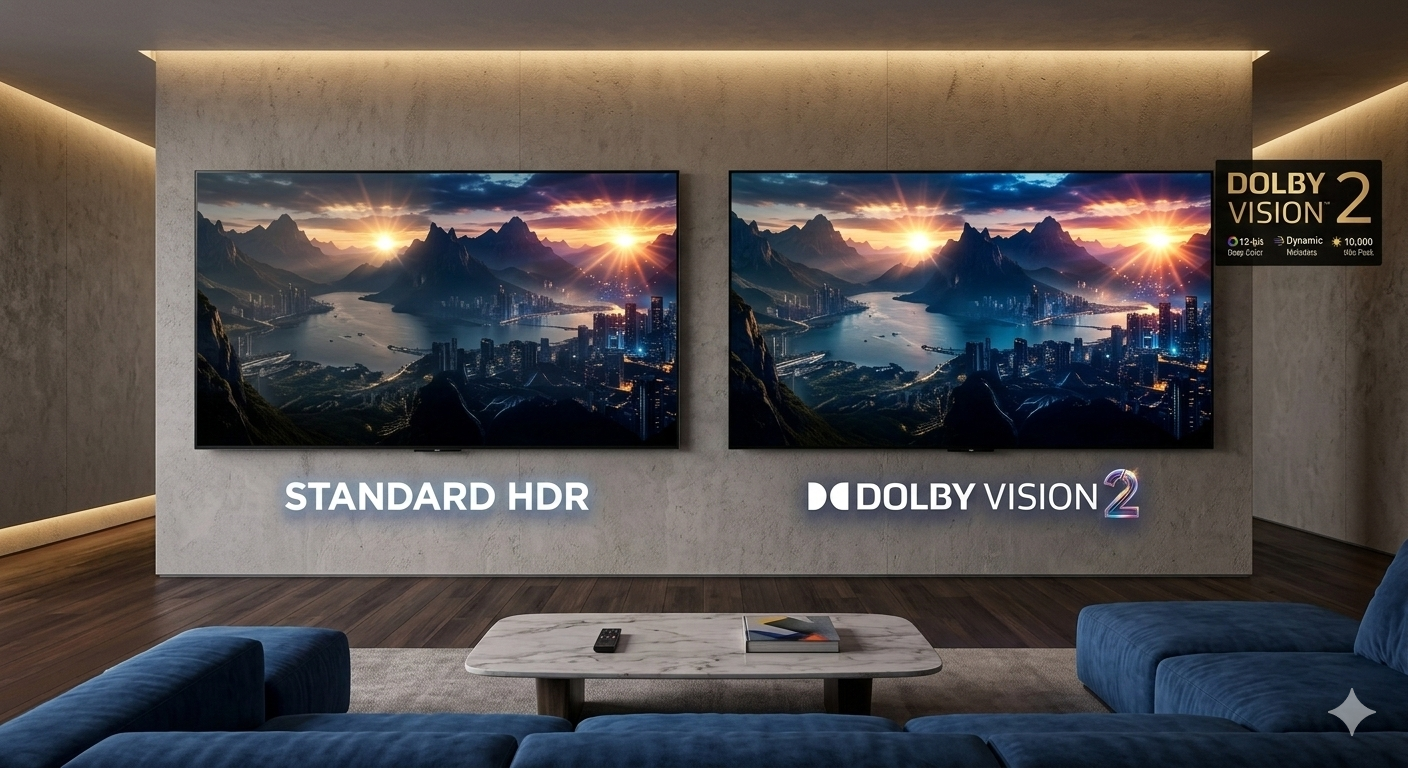
Dolby Vision vs Dolby Vision 2
Now let’s talk about the actual differences.
The two technologies share the same basic concept, but Dolby Vision 2 introduces some improvements.
1. Better Brightness Handling
The brightness of modern televisions is far greater than the older HDR displays.
Dolby vision 2 enhances the way HDR contents can be adjusted within such brighter screens.
To put it in practice, this would imply:
• Bright highlights appear more detailed
• Light reflections look more natural
• Scenes with strong brightness contrast stay balanced
As an example, the reflection of the sun on water or the bright blasts in the films can be more realistic.
2. More Accurate Color Gradients
Color handling is another area where Dolby Vision 2 improves things.
While Dolby Vision already supported very deep color depth, newer displays are capable of showing these colors more precisely.
Dolby Vision 2 refines how colors are mapped to the screen.
This helps create smoother color transitions in scenes like:
• Sunsets
• Blue skies
• Ocean scenes
• Landscapes
Instead of visible color steps, the transitions look more natural.
3. Better Optimization for Modern TV Panels
Television technology has changed a lot in recent years.
Today many premium TVs use:
• OLED panels
• Mini LED backlighting
• High brightness LCD displays
Dolby Vision 2 is created to be much more compatible with these new panels.
This enables TVs to retain details in both extremely dark and extremely bright areas of an image.
Shadow and bright light combination scenes may seem more balanced.
4. Better Streaming Efficiency
Most people nowadays watch movies and shows through streaming.
Dolby Vision 2 enhances the delivery of the HDR video on streaming services.
The goal is simple.
• Maintain high picture quality
• Use bandwidth more efficiently
This allows streaming services to deliver better HDR video without dramatically increasing internet requirements.
Where Dolby Vision 2 Is Available Right Now
Since the technology is still new, availability is limited.
At the moment the rollout mainly includes:
• Early support in premium Hisense TV models
• Interest from streaming platforms like CANAL+
• Gradual expansion expected over the next couple of years
Most other TV brands have not yet widely introduced support.
Because of this, Dolby Vision 2 content is still rare.
For most viewers, the experience will remain the same as standard Dolby Vision for now.
Will You Notice a Big Difference?
This is the question many people ask.
The honest answer is that the difference depends on your TV.
If you already own a good Dolby Vision TV, the improvement from Dolby Vision 2 may not feel dramatic right now.
However, newer high-brightness TVs may benefit more from the updated processing.
You may notice improvements in scenes with:
• Very bright highlights
• Strong contrast between light and dark
• Subtle color gradients
But the overall picture quality still depends heavily on the TV panel itself.
Is Upgrading Worth It?
In case you are willing to purchase a new TV soon, it may be worth paying attention to Dolby Vision 2 support.
But at present, there is likely no need to upgrade for Dolby Vision 2 only.
This is how one can think practically about it.
In case you have an existing TV that supports Dolby Vision:
• The picture quality is already excellent
• The difference may not justify replacing your TV
In case you already need to purchase a new television:
• It may be more future-proof to pick a model with Dolby Vision 2
At the current stage the technology is just too young to become a significant decisive factor to the majority of buyers.
When Dolby Vision 2 Will Be Mainstream
The Dolby vision 2 is relatively new and has not been widely adopted yet.
It is only supported by some few devices and streaming sites are only setting up to understand the format.
According to most industry pundits, it is likely to become widespread in the coming one to two years.
Dolby Vision 2 will slowly become the standard in the highest quality HDR viewing as more brands of TVs embrace the technology and streaming services start supporting it.
However, in the meantime standard Dolby Vision remains the leader.
Frequently Asked Questions
1. Does Dolby Vision 2 and Dolby Vision differ entirely?
No. Dolby Vision 2 is based on the same technology, but it also had some enhancements with brightness management, color accuracy, and display control.
2. Is Dolby Vision 2 currently very popular?
Not yet. It remains at the initial adoption stage and has only been supported by a few devices at the moment.
3. What are the first TVs that support Dolby vision 2?
The first models that may support the new technology are some premium models of Hisense TV.
4. Are streaming sites compatible with Dolby Vision 2?
It is not fully supported yet, but certain platforms like CANAL+ have already expressed interest.
5. Should I upgrade my TV to Dolby Vision 2?
Unless you already have a Dolby vision TV, you may not need to upgrade to Dolby vision 2 at this point.
Final Thoughts
Dolby Vision is already one of the most significant technologies that can be used to view HDR in the modern world.
It enhanced brightness, contrast and color of the TVs scene by scene.
Dolby Vision 2 expands that concept by advancing the technology to new and more competent displays.
It is currently at an early stages of rollout. It is only supported by a few TVs and streaming companies are just starting to embrace it.
To the majority of viewers, the standard Dolby Vision is already providing them with great picture quality.
Dolby Vision 2 will probably become more widespread in the nearest future, yet at the point it is rather more of an upgrade of the future than a necessity of most people.
It is worth having an eye on it in case you are planning to purchase a new TV anyway. Otherwise, your existing Dolby Vision system will remain an excellent viewing experience.
Sources
You May Also Like
Top Portable Mini Projectors for Home & Travel in 2026
Best AI Tools for Productivity That Are Changing the Way We Work
Smart Device Security Tips: A Simple Guide to Protect Your Connected Home
Quick Links
© 2025 Gadget Nexus Pro. All rights reserved